Category: Covenants

  • Post 6 — The Outer Altar: Where Covenant Access Begins

    Post 6 — The Outer Altar: Where Covenant Access Begins

    Jim Bibb

    Oct 14, 2026

    In the previous post, we identified the legal parties revealed by the Temple:

    • The Father
    • His Word
    • The Twelve Tribes of Israel

    Every covenant requires more than participants. It requires a point of entry.

    How does a covenant relationship begin? How does someone move from being outside a covenant to becoming part of it?

    Scripture consistently answers that question with a boundary, a doorway, or a threshold.

    This is why the outer altar stands at the entrance of Temple worship. Before anyone could approach the Holy Place or the Most Holy Place, they first encountered the outer altar.

    The outer altar was not simply a place of offerings. It was a covenant threshold.

    1. Thresholds Are More Than Doorways

    Modern readers often think of a threshold as little more than a doorway. In the ancient world, a threshold carried legal meaning.

    It marked the boundary between:

    • outsider and insider
    • stranger and family
    • foreign jurisdiction and covenant jurisdiction
    • danger and protection
    • separation and relationship

    We still preserve traces of this understanding today. A groom carries his bride across the threshold of a new home. The gesture is symbolic, but it reflects a much older covenant reality.

    A threshold covenant establishes a relationship between a greater party and a lesser party. The greater party offers provision, protection, inheritance, and belonging. The lesser party accepts the terms of the covenant and pledges fidelity.

    In marriage, a husband assumes responsibility for providing for and protecting his household. The bride responds with covenant fidelity, reserving the privileges of marriage exclusively for her husband. The marriage relationship is not destroyed merely because the bride makes mistakes. It is threatened when she gives to another man what belongs exclusively to her husband.

    This is why adultery occupies such a unique place among covenant violations. Adultery is not merely the breaking of a rule. It is the rejection of the covenant relationship itself.

    The same pattern appears throughout Scripture.

    The Father, working through His Word, offers Abraham provision, protection, inheritance, and blessing. Abraham responds with covenant loyalty and fidelity.

    Israel’s covenant operates in the same way. The Father provides the Land, protection, instruction, and covenant blessing through His Word. Israel’s obligation is fidelity expressed through exclusive worship of the Father through the One who bears His Name.

    This helps explain why Scripture repeatedly describes idolatry as adultery. Idolatry is not merely incorrect worship. It is the giving of covenant fidelity to another god.

    Just as adultery transfers exclusive intimacy to someone outside the marriage covenant, idolatry transfers covenant loyalty to someone outside the covenant relationship. Both are acts of covenant rejection.

    This covenant logic stands at the heart of the biblical story. It explains the divorce language of Deuteronomy 24, Jeremiah 3, Hosea 1, and Romans 7. It also explains why the restoration of the twelve tribes becomes such a central concern of the prophets.

    Before Scripture tells the story of Israel’s restoration, it first explains Israel’s unfaithfulness. Before there can be return, there must first be a breach of fidelity.

    In his influential 1896 work The Threshold Covenant, now in the public domain and freely available online, H. Clay Trumbull documented threshold customs across the ancient world and argued that the threshold functioned as humanity’s earliest altar and covenant boundary. Blood poured at a threshold marked jurisdiction, covenant loyalty, protection, and belonging. This broader context helps modern readers understand why Scripture repeatedly links altars, doorways, covenants, and restoration.

    2. Why the Outer Altar Comes First

    This helps explain the placement of the outer altar. When approaching the Tabernacle or the Temple, the outer altar is encountered before anything else. That order is intentional. The Father’s restoration plan does not begin in the Most Holy Place. It begins at a threshold.

    Before there can be fellowship, there must be covenant. Before there can be access, there must be belonging. Before there can be restoration, there must be entry.

    The outer altar represents that entry point. It is the place where covenant jurisdiction is acknowledged and covenant relationship begins. The Temple teaches this reality through a precise legal blueprint. The outer altar stands at the beginning because covenant access always comes before deeper covenant experience.

    3. Noah and the First Covenant Altar

    The first altar specifically mentioned in Scripture appears after the flood. Following judgment, Noah builds an altar and presents offerings before the Father.

    In response, the Father declares:

    “While all the days of the earth remain, seedtime and harvest, cold and heat, summer and winter, day and night will not cease” (Genesis 8:22, TLV).

    This moment is more than gratitude after survival. It marks the beginning of restoration. The flood represents judgment. The altar represents a threshold.

    The covenant that follows establishes a renewed relationship between the Father and humanity. Noah’s altar becomes a threshold between judgment and restoration, demonstrating a pattern that will appear again and again throughout Scripture.

    Notice the pattern:

    • judgment
    • threshold
    • covenant
    • restoration

    This same pattern appears repeatedly throughout Scripture. The Father continually moves people from chaos toward restoration, and covenant thresholds mark the transition.

    4. Abraham Crosses the Threshold

    The pattern becomes even more significant with Abraham. When Abraham is called to leave his homeland and enter the land promised by the Father, Scripture records that he builds an altar after arriving (Genesis 12:7, TLV).

    This detail is easy to overlook. Yet it reveals something profound.

    Abraham does not merely travel into a new territory. He enters a covenant jurisdiction. The altar marks that transition.

    Later, after separating from Lot, Abraham builds another altar (Genesis 13:18, TLV).

    Again the pattern appears:

    • promise
    • entry
    • altar
    • covenant

    These altars are not random acts of devotion. They are legal acts of covenant acceptance.

    The Father, through His Word, had already extended promises of provision, protection, land, and blessing to Abraham (Genesis 12:1-3). By crossing into the Land and establishing a threshold altar, Abraham formally accepts those promises and enters into covenant relationship with the Father through the One who appeared to him.

    This pattern echoes the structure of a marriage covenant.

    The wedding covenant establishes the relationship. The ongoing intimacy of marriage does not create a new covenant each time, but it nourishes, renews, and affirms the relationship already established.

    The same principle applies to Abraham’s altar worship. The first altar marks covenant entry. The continuing offerings affirm covenant fidelity and ongoing participation in the relationship.

    This helps explain why Scripture treats idolatry as spiritual adultery. The issue is not merely improper worship. The issue is covenant infidelity.

    The Father offered provision, protection, inheritance, and blessing.

    Israel was called to respond with exclusive covenant loyalty through worship of the Father by means of His Word. To direct that loyalty elsewhere was more than disobedience. It was the rejection of the covenant itself.

    The threshold comes first. Everything else follows from it.

    5. Abraham’s Altars and the Temple Pattern

    Long before there was a Tabernacle, Abraham was already living out the covenant pattern that would later be embodied in the Temple.

    His altars foreshadow the outer altar. His entry into the Land foreshadows covenant access. His acceptance of the promise foreshadows Israel’s future covenant relationship with the Father.

    The Temple did not invent this pattern. The Tabernacle and subsequent Temples institutionalized it.

    What Abraham practiced personally, Israel would later practice nationally. The outer altar became the permanent reminder that covenant begins with a threshold and that restoration begins with entry.

    6. Why Thresholds Matter

    Understanding thresholds helps explain many of Scripture’s most important events.

    Passover is built upon threshold logic. The Temple’s outer altar is built upon threshold logic. The Abrahamic covenants are built upon threshold logic.

    Even the future restoration of Israel is described in terms of covenant return and renewal. Every major covenant movement in Scripture involves crossing a boundary and entering a new relationship.

    Thresholds mark that moment. They are the legal boundaries of covenant access.

    Closing Thought

    Before there was a Temple, there was an altar. Before there was a nation, there was Abraham. Before there was covenant life in the Land, there was a threshold marking entry into it.

    The outer altar stands at the beginning of the Temple because covenant access always comes first.

    Yet covenant access is only the beginning. Every threshold covenant creates obligations. The greater party extends provision, protection, and belonging. The lesser party responds with fidelity.

    The rest of Israel’s story, including exile, divorce, restoration, and ultimately redemption, flows from whether that fidelity is maintained or rejected.

    In the next post, we’ll examine Abraham’s encounter with Melchizedek in Genesis 14 and explore the covenants of salt and blood as some of the most overlooked foundations of covenant loyalty, representation, and restoration in all of Scripture.
  • Post 5 — Israel’s Temple Is a Covenant Blueprint: Identifying the Legal Parties

    Post 5 — Israel’s Temple Is a Covenant Blueprint: Identifying the Legal Parties

    Jim Bibb

    Oct 07, 2026

    Most people view the Temple as a place of worship.

    It certainly was that. Covenant offerings were presented there. The priesthood and Levites helped guide Israel into covenant remembrance, restoration, and realignment with the Father. The twelve tribes gathered there at appointed times to celebrate His faithfulness, acknowledge His provision, and renew their covenant identity.

    Yet the Temple was also something more.

    It was a covenant blueprint.

    Its furnishings were not arranged randomly. Specific objects and their locations revealed participants in the Father’s restoration plan. Together, they formed a legal map that identified the covenant parties and explained how Heaven and Earth interact.

    Once we understand who these parties are, many of Scripture’s most difficult questions become easier to answer.

    Questions such as:

    • Why does Messiah mediate between the Father and humanity beginning in Genesis?
    • Why does Israel remain central to the biblical story?
    • Why are there multiple covenants?
    • Why does Jeremiah 31 focus on the House of Israel and House of Judah?
    • Why does the book of Hebrews devote so much attention to priesthood and Temple service?

    The Temple answers these questions by identifying the legal parties themselves.

    1. The Temple Is More Than a Worship Center

    When the prophet Ezekiel was shown the future Temple, he was instructed to pay close attention to its design and measurements (Ezekiel 43:10-11).

    This raises an important question:

    Why would God spend so much time describing architecture?

    Because the Temple was designed to teach.

    Its measurements reveal order.

    Its furnishings reveal relationships.

    Its layout reveals authority.

    Its offerings reveal covenants.

    The Temple functions as a visual representation of the Father’s restoration plan. It teaches theology through architecture, covenant through form and function, and restoration through recurring rhythms of worship, remembrance, and renewal.

    Before we can fully understand the covenants themselves, we must first identify the covenant partners.

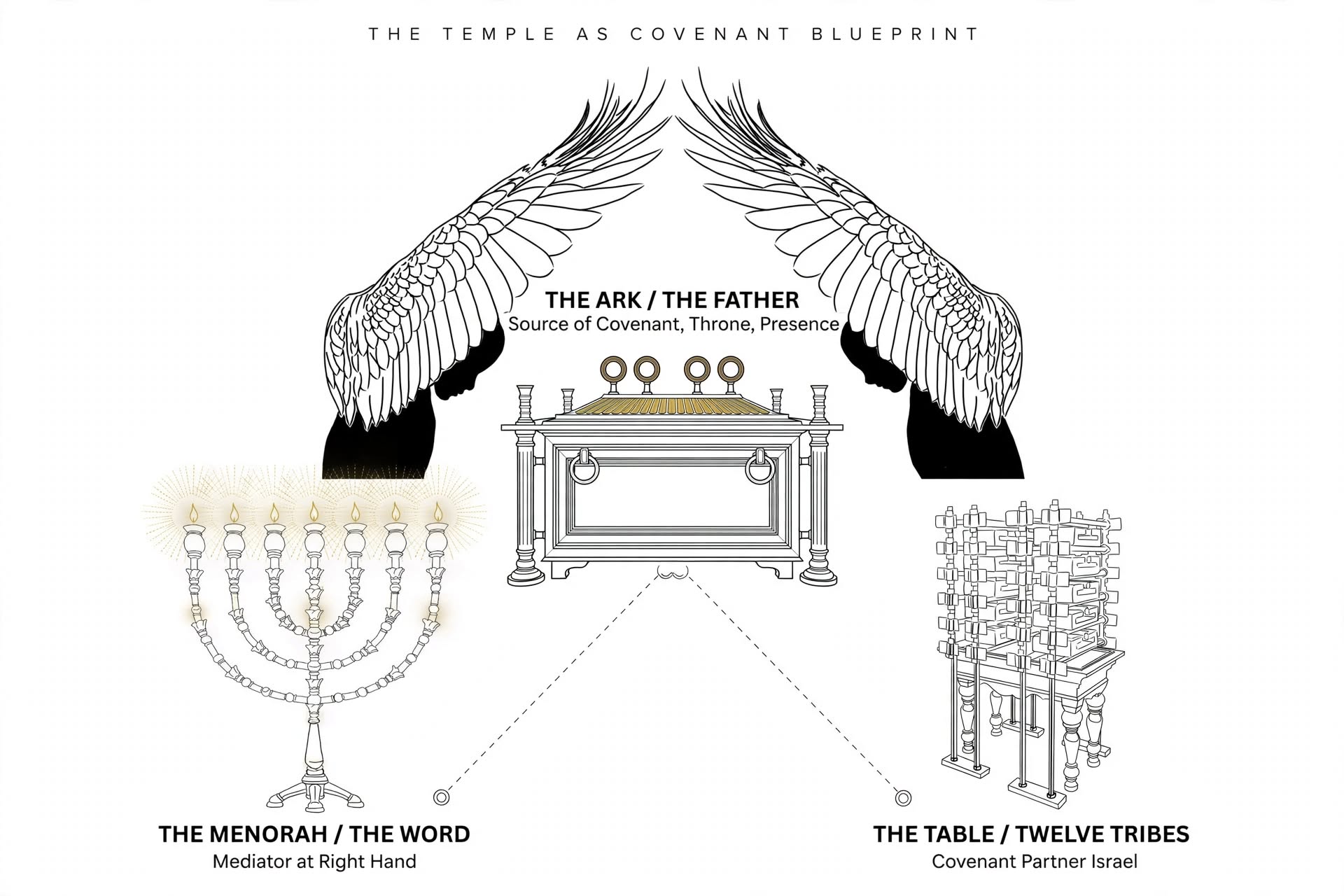
    2. The Ark Reveals the Father

    At the center of the Temple stood the Holy of Holies.

    Within it rested the Ark of the Covenant.

    Specifically, the space just above the Ark and between the cherubim represented:

    • the Father’s throne
    • His authority
    • His kingdom
    • His presence

    From the Ark came covenant.

    From the Ark came instruction.

    From the Ark came judgment and mercy.

    The Father is the source of every covenant and every restoration plan. The biblical story begins with Him and ultimately ends with humanity dwelling in His presence.

    Yet after Eden, humanity could no longer endure the fullness of that presence.

    As we discussed in Post 2, the Father withdrew His immediate glory following mankind’s rebellion. Humanity moved from light to skin, from direct presence to mediated presence.

    That change created the need for a mediator.

    The Ark reveals the covenant source: the limitless Father who desires to be chosen by those who possess the ability to either choose or reject Him. The rest of the Temple explains how fallen humanity is brought back into right relationship with Him.

    3. The Menorah Reveals the Word

    Standing in the Holy Place was the Menorah.

    Most readers see a lampstand.

    The Temple reveals something much more profound.

    The Menorah represents the Word, the One who bears the Father’s Name and carries out the Father’s will within creation, positioned in authority at the Father’s right hand.

    Throughout Scripture we encounter this same figure:

    • the Word through whom creation comes into being
    • the Voice walking in the Garden
    • the Messenger bearing the Father’s Name
    • the Redeemer who appears throughout Israel’s history
    • the High Priest who ministers on behalf of humanity

    The Menorah illuminates the Holy Place just as the Word brings revelation into creation.

    The Father remains enthroned.

    The Word mediates His presence.

    This explains why Messiah occupies such a central role in covenant. He is not a replacement for the Father. He is the Father’s authorized representative, the mediator through whom covenant operates.

    The Temple teaches this truth visually long before the books of the New Testament were written.

    4. The Table Reveals Israel

    Directly opposite the Menorah stood the Table of Showbread.

    Upon it rested twelve loaves.

    The number is not accidental.

    Not ten.

    Not two.

    Not one.

    Twelve.

    The Table represents the Twelve Tribes of Israel continually standing before the Father.

    This may be one of the most overlooked symbols in the entire Temple.

    Many readers assume the covenant partner is humanity in general. Yet the Table identifies the specific covenant partner addressed throughout Scripture.

    The covenant partner is Israel.

    This is why Jeremiah 31 does not address “the world.”

    It addresses:

    • the House of Israel (ten tribes)
    • the House of Judah (two tribes)

    The Table reminds us that covenant is relational and legal. It identifies the covenant recipient standing before the Father through the mediation of the Word.

    The nations are not excluded from this arrangement. Rather, they are invited into it through Messiah and through covenant connection to Israel’s calling.

    5. The Temple Reveals the Covenant Parties

    When the primary furnishings are viewed together, a remarkable pattern emerges:

    Temple Furnishing Covenant Party

    Ark of the Covenant The Father

    Menorah The Word / Messiah

    Table of Showbread The Twelve Tribes of Israel

    These are the legal parties revealed by the Temple.

    The Father initiates.

    The Word mediates.

    Israel receives, carries, and displays covenant life before the nations.

    These are not merely symbolic figures. They occupy defined covenant positions with distinct responsibilities, obligations, and authority within the Father’s restoration plan.

    This covenant structure explains why Messiah’s role cannot be separated from Israel’s role.

    It also explains why the restoration of the Twelve Tribes remains central to the biblical narrative. The covenant partner identified by the Table has never been replaced.

    The Temple continues to testify to that reality.

    6. Why This Matters for Understanding the Covenants

    The legal parties help explain the covenant architecture we explored in Post 4.

    The inner-altar covenant is the one established through Abraham and Isaac in Genesis 22 and activated by the blood of the Seed, Messiah, for the eventual restoration of humanity back to the Father.

    The outer-altar covenant focuses primarily on the relationship between the Word and His covenant Bride, the Twelve Tribes of Israel, as they were intended to and will once again dwell in the Land promised to Abraham.

    Understanding the parties helps us understand the covenants.

    Without identifying the participants, it becomes easy to merge distinct covenants together or assume that Israel no longer plays a unique role in the Father’s restoration plan.

    The Temple prevents that confusion.

    Its architecture identifies the participants before it teaches the details of their covenants.

    7. A Temple of Restoration

    The more closely we study the Temple, the more a larger pattern begins to emerge.

    Everything in Scripture moves toward restoration.

    The Father restores Adam and Eve after rebellion.

    He restores Noah after judgment.

    He restores Abraham through covenant.

    He restores Israel from slavery.

    He restores His people through the appointed times.

    He restores humanity through Messiah.

    He restores creation through resurrection.

    Ultimately, He restores Heaven and Earth through the New Jerusalem.

    The Temple stands at the center of that story.

    Its offerings, priesthood, appointed times, and covenant relationships all point toward the same goal: bringing creation back into alignment with its Creator.

    The Temple is not merely a place where people worshipped the Father.

    It is a place that teaches how the Father restores people to Himself.

    Closing Thought

    The Temple does not merely contain sacred furniture.

    It reveals sacred relationships.

    The Ark reveals the Father.

    The Menorah reveals the Word.

    The Table reveals the Twelve Tribes of Israel.

    Together, they identify the legal parties of the biblical covenant story and provide the framework for understanding everything that follows.

    For readers who want to explore the Temple’s covenant architecture in greater depth, Israel Divided: Why Jesus Came develops this framework step by step.

    In the next post, we’ll begin exploring how these legal parties enter covenant with one another by examining the threshold covenant established between the Word, acting on behalf of the Father, and Abraham in Genesis 12-14. That covenant becomes the foundation of the Temple, the covenants that follow, and ultimately the restoration story itself.

  • Post 4 — Two Covenants, One Messiah: The Temple’s Outer Altar Sinai Covenant and the Inner Altar Better Covenant

    Post 4 — Two Covenants, One Messiah: The Temple’s Outer Altar Sinai Covenant and the Inner Altar Better Covenant

    Why Jeremiah 31 and Hebrews 8 Speak of Different “New” Covenants

    Jim Bibb

    Sep 16, 2026

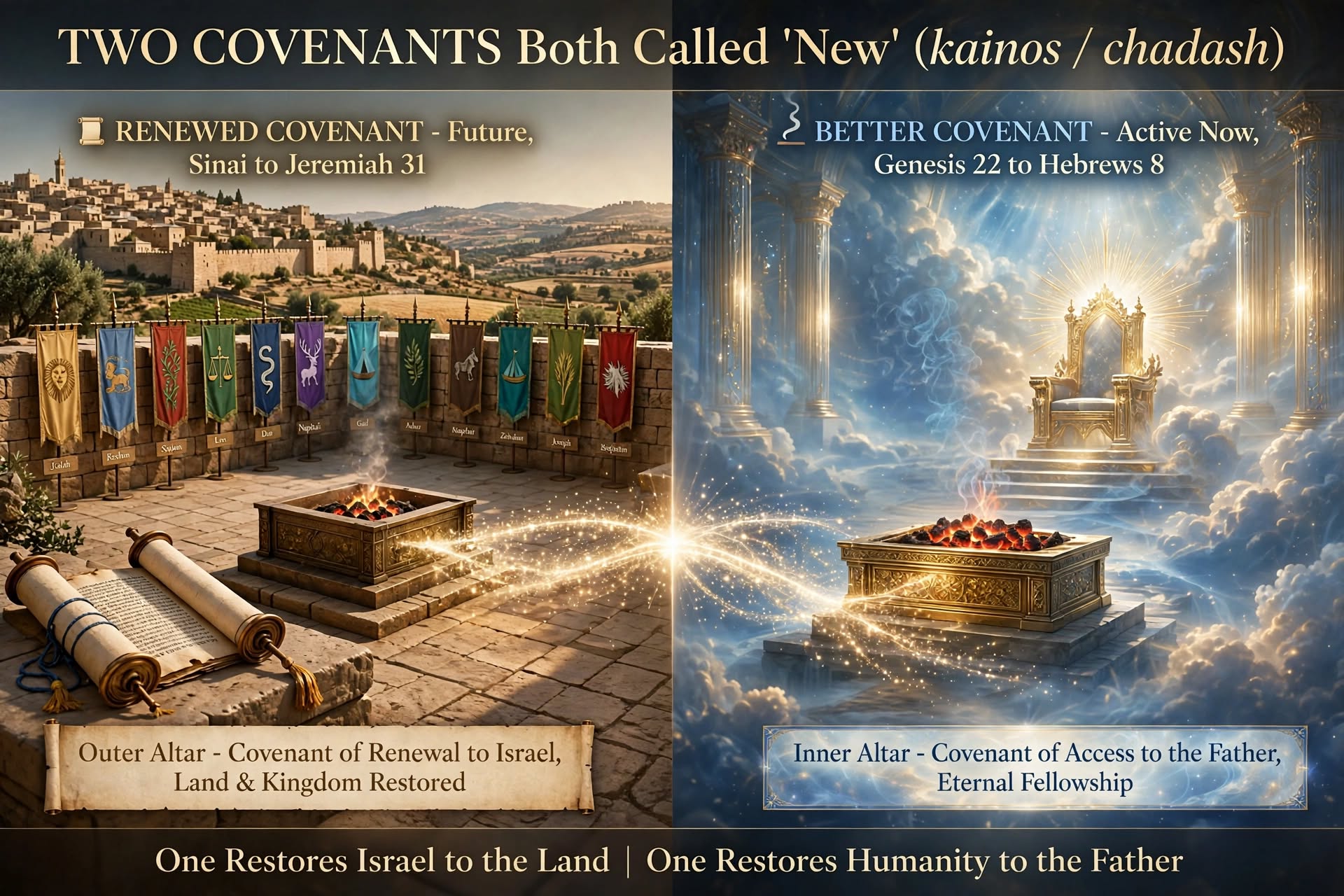
    Most Christians assume the “new covenant” is a single covenant activated at the death of Jesus. Yet Scripture presents two distinct covenants, both called “new” in English, both described with the Greek word kainos, and both fulfilled by Messiah. However, they operate on different altars in the Temple, serve different purposes, and unfold on different timelines.

    This post explains why the renewed covenant of Jeremiah 31 and the better covenant of Hebrews 8 are not the same covenant, why they are often confused, and how Messiah fulfills both in their proper order.

    1. The Problem: English Uses One Word for Two Different Covenants

    English translations use the phrase “new covenant” for:

    · Jeremiah 31’s renewed national covenant for the reunited Twelve Tribes of Israel.

    · Hebrews 8’s better eternal covenant that restores humanity back to the Father following the Messianic Kingdom.

    Because the same English phrase is used for both, most readers assume they are identical. They are not. The Hebrew and Greek behind these passages tell a different story.

    2. The Hebrew: One Covenant Is Renewed, Not Brand‑New

    Jeremiah 31 uses the Hebrew word chadash (חָדָשׁ). While chadash can mean “brand‑new” in some contexts, something never seen before, the context of Jeremiah 31 does not allow that meaning. Here, chadash clearly means:

    · renewed

    · restored

    · made new again

    · refreshed

    Jeremiah 31 is the renewal of the Sinai covenant, not the creation of a brand‑new covenant with new terms or new partners. The covenant is made with:

    · the House of Israel

    · the House of Judah

    These are the same Twelve‑Tribe covenant partners as Sinai, which means the covenant is being restored, not replaced. It is national, tribal, land‑based, and kingdom‑oriented.

    It requires:

    · the reunification of the Twelve Tribes

    · return to the Land

    · Messiah reigning in Jerusalem

    · Torah written on hearts

    · the restored kingdom

    · the restored Presence

    None of these have happened yet. Therefore, Jeremiah 31 is future.

    3. The Greek: One Word, Two Contexts

    The Greek word used in both Jeremiah 31 (LXX) and Hebrews 8 is:

    kainos — renewed, fresh, restored, or brand‑new, depending on context

    Like the Hebrew chadash, kainos can mean two different things:

    · renewed — something restored or made new again

    · brand‑new — something activated for the first time

    The meaning depends entirely on the covenant being described.

    Jeremiah 31 uses kainos/chadash in the “renewed” sense. The Sinai covenant was “new” when given at Sinai. Jeremiah 31 describes that same covenant being renewed for the reunited Twelve Tribes in the future Messianic Kingdom.

    Hebrews 8 uses kainos in the “brand‑new” sense. The Genesis 22 → Hebrews 8 covenant (the inner‑altar covenant of restoration to the Father in eternity) was activated for the first time by Messiah’s blood. The blood of bulls and goats on Yom Kippur served only as a placeholder, pointing forward to the moment Messiah would inaugurate the better covenant in the Heavenly Temple.

    In other words, the inner‑altar covenant was not a renewal of something old, but the inauguration of something that had never been activated before.

    This is where confusion arises:

    Hebrews 8 compares the brand‑new inner‑altar covenant with the yet‑to‑be‑renewed Jeremiah 31 covenant. Without understanding Temple form and function, especially the two‑altar structure, readers assume Hebrews is applying Jeremiah 31 directly to the present age. Yet Hebrews is not describing Jeremiah 31’s renewed Sinai covenant.

    Hebrews explicitly cites Jeremiah 31, but uses it to argue for Messiah’s superior heavenly priesthood and the activation of the better inner‑altar covenant, not to claim that Jeremiah 31 has been fulfilled. The renewed Sinai covenant of Jeremiah 31 is future, national, tribal, and land‑based, and will only be activated when the Twelve Tribes are restored and the Messianic Kingdom is established.

    Hebrews is describing the Genesis 22 → Hebrews 8 covenant, the inner‑altar covenant of restoration to the Father in eternity. The author of Hebrews assumes the reader understands Temple form and function. Without the two‑altar structure, his argument cannot be followed.

    4. The Inner‑Altar Covenant: Genesis 22 → Hebrews 8 (Better Covenant)

    This covenant is:

    · eternal

    · heavenly

    · priestly

    · resurrection‑based

    · mediated by Messiah

    · accessible to all nations, though administered through Israel’s priestly identity

    · active now

    It is the covenant Messiah activated when He:

    · died

    · rose

    · ascended

    · entered the heavenly Holy of Holies

    · sat at the right hand

    · became High Priest forever in the Heavenly Temple

    This is the better covenant of Hebrews 8, the covenant that ultimately restores humanity to the Father. It is the inner‑altar covenant, the covenant of eternal life. This covenant is already active.

    5. The Outer‑Altar Covenant: Sinai → Jeremiah 31 (Renewed Covenant)

    This covenant is:

    · national

    · tribal

    · land‑based

    · kingdom‑oriented

    · renewed by Messiah as Groom to Israel at His return

    · dependent on Israel’s restoration

    · future

    It is the covenant Messiah activates when He:

    · returns

    · gathers the Twelve Tribes

    · restores the kingdom

    · reigns from Jerusalem

    · renews the Sinai covenant

    · writes Torah on hearts

    · restores the Presence to Zion

    This is the renewed covenant of Jeremiah 31. It restores Israel to the Land. It is the outer‑altar covenant, the covenant of the Messianic Age. This covenant has not yet been reactivated because the Twelve Tribes have not yet been restored.

    The Passover Threshold Transfer

    Just as Israel was safely inside the covenant threshold during Passover in Egypt, covenant‑connected Judah was safely inside the covenant threshold when Messiah died. His blood deactivated the outer‑altar covenant as a marriage covenant and simultaneously activated the inner‑altar covenant of restoration to the Father in eternity. Because Judah remained inside the covenant, her transfer into the better covenant was seamless, the legal movement of a covenant widow whose rights were preserved, not erased. The rest of humanity enters through grafting, brought into the inner‑altar covenant through Messiah rather than through prior covenant standing.

    6. Why Christians Confuse the Two

    Three reasons:

    1. English uses “new covenant” for both.

    This collapses the distinction.

    2. Greek uses kainos for both.

    This allows overlap in language but not in meaning.

    3. Hebrews 8 quotes Jeremiah 31 — but applies it differently.

    Hebrews quotes Jeremiah 31 to show the superiority of Messiah’s heavenly priesthood, not to claim Jeremiah 31 is already fulfilled or obsolete. Hebrews is describing the inner‑altar covenant, not the outer‑altar covenant.

    7. How Messiah Fulfills Both Covenants

    Messiah fulfills both covenants, but in order, not simultaneously.

    First: the inner‑altar covenant (Genesis 22 → Hebrews 8)

    · activated at His death, resurrection, and ascension

    · grants eternal access to the Father

    · restores humanity to glory

    Second: the outer‑altar covenant (Sinai → Jeremiah 31)

    · activated at His return

    · reunites the Twelve Tribes

    · restores the kingdom

    · renews the Sinai covenant

    · restores Israel to the Land

    One covenant restores humanity to the Father. The other restores the Twelve Tribes of Israel to the Land. Both are necessary, both are beautiful, and both are fulfilled by Messiah. But they are not the same covenant.

    Closing Thought

    Scripture presents two covenants that English translations both call “new,” but they are distinct in purpose, scope, altar, and timeline. The better covenant of Hebrews 8, the inner‑altar covenant, is already active through Messiah’s death and resurrection. The renewed covenant of Jeremiah 31, the outer‑altar covenant, awaits the restoration of the Twelve Tribes and Messiah’s reign in Jerusalem.

    Understanding this distinction allows us to read Scripture with clarity, honor both covenants, and see Messiah’s work in its full beauty, restoring humanity to the Father and restoring Israel to the Land. For readers who want to explore the Temple’s two‑altar structure and the covenant architecture behind these passages in greater depth, Israel Divided: Why Jesus Came explains this framework step‑by‑step.

  • Post 2 — The Origin of Covenant: Why Humanity Needed a Path of Return

    Post 2 — The Origin of Covenant: Why Humanity Needed a Path of Return

    Jim Bibb

    Sep 02, 2026


    Most people begin the story of Messiah in the New Testament. Yet Scripture begins His story much earlier, in Eden, in the moment humanity lost its original glory and the Father established the need for covenant.

    Chapter 2 of Israel Divided: Why Jesus Came reveals this foundation: Covenant begins with the withdrawal of glory, the giving of skin, and the rise of blood as the legal medium of restoration.

    Thanks for reading! Subscribe for free to receive new posts and support my work.Subscribe

    This is where the story truly begins.

    1. Humanity Was Originally Clothed in Light

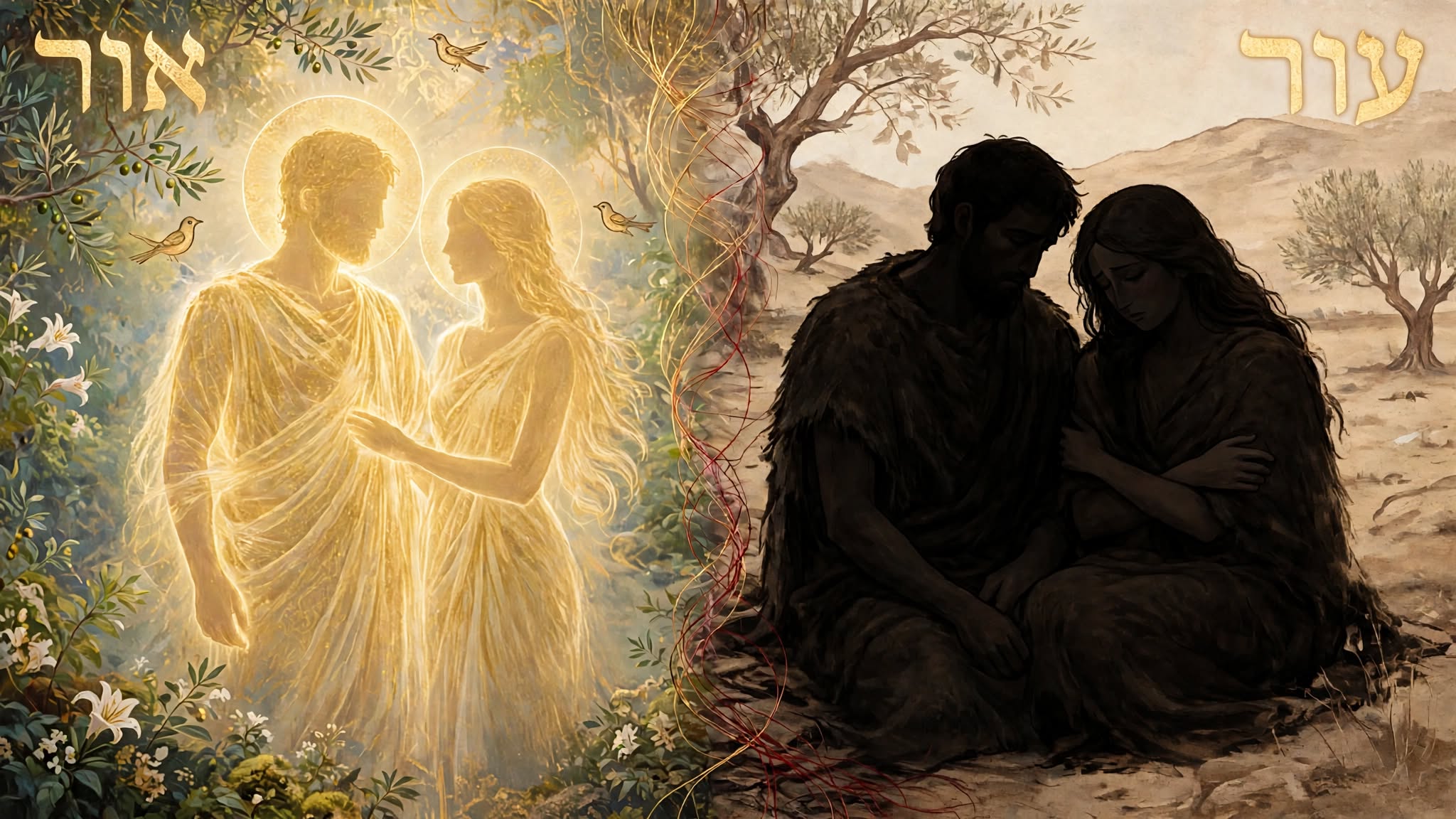
    Before we look at the transformation from light to skin, it helps to know that Scripture uses a deliberate Hebrew wordplay here. Two different Hebrew words sound identical when pronounced as “or” but are spelled differently and mean very different things. One is light (spelled with the Hebrew letter aleph, אוֹר) and the other is skin (spelled with the Hebrew letter ayin, עוֹר).

    This wordplay is intentional and foundational to understanding covenant.

    Genesis 3:21 says the Father made “garments of skin” for Adam and Eve. Before the fall, they were clothed in light (אוֹר), radiant coverings reflecting the Father’s presence. Psalm 8 describes humanity as crowned with glory and honor, ruling over the works of His hands.

    Humanity was created to bear divine glory. When Adam and Eve sinned, the Father withdrew His fullness. Not in anger but in mercy. No will contrary to His can exist in His presence.

    The withdrawal of glory transformed humanity:

    · from beings of light (אוֹר)

    · into beings clothed in skin (עוֹר)

    This “skin” was not animal hide. It was human flesh itself, a new condition designed to contain blood, which in a fallen world became:

    · humanity’s lifeforce

    · and the legal currency of covenant

    This is why Adam and Eve felt naked. The glory was gone.

    2. Humanity Could No Longer Endure the Father’s Fullness

    Genesis 3:8 says Adam and Eve heard “the voice of YHWH Elohim walking.” The Hebrew emphasizes qol, voice, not a physical form. The ancient Aramaic Targums make this explicit:

    “They heard the voice of the Word of the Lord God.”

    Humanity could no longer endure the Father’s fullness. So the Word, the Memra, appeared as His representative, bearing His Name and authority.

    This moment reveals the new reality:

    · humanity in skin

    · the Father withdrawn

    · the Word mediating

    · blood becoming the legal means of restoration

    This is the foundation of covenant.

    3. Covenant Means Cutting and Restoration

    The Hebrew word berit (covenant) carries two meanings at its root:

    · bara — to cut, to open

    · barah — to rejuvenate, to restore

    Covenant is both incision and renewal.

    Humanity clothed in skin and blood requires covenant to be reconciled and returned to glory. The cut accesses the blood. The blood restores.

    After Eden, covenant becomes the Father’s blueprint for humanity’s return.

    4. Light, Skin, Blood, and the Image of God

    Genesis 1 says humanity was created in the image of God.

    In His eternal form, Messiah is a being of light, the same light spoken in Genesis 1:3.

    Chapter 2 of Israel Divided: Why Jesus Came explains the pattern:

    · Humanity in Eden: clothed in light, reflecting divine glory

    · Humanity after the fall: clothed in skin, containing blood

    · Messiah before taking on flesh: the Word appearing in created time and space, bearing the Father’s Name and authority

    · Messiah in human flesh: the Word entering skin and shedding blood to restore humanity

    The flesh and blood given to Adam and Eve anticipate the flesh and blood of Messiah. What humanity lost, Messiah restores.

    Closing Thought

    Covenant is not sentiment. It is the Father’s legal and relational blueprint for reconciliation. Chapter 2 reveals the moment that blueprint became necessary, when humanity lost glory, received skin and blood, and could no longer endure the Father’s fullness. From that point forward, covenant became the path of return.

    This is the beginning of the restoration story Israel Divided: Why Jesus Came unfolds chapter by chapter.