Oct 21, 2026
In our last post, we explored how Abraham entered covenant relationship with the Father through the threshold covenant. By crossing into the Land and establishing altars, Abraham formally accepted the Father’s promises of provision, protection, inheritance, and blessing.
Covenant relationships do not end at the threshold. They deepen through additional agreements. Genesis 14 records the next major step in Abraham’s covenant journey, an encounter with one of the most mysterious figures in Scripture.
Melchizedek.
Most discussions focus on a single question:
Who is Melchizedek?
While that question matters, an equally important question is often overlooked: What commitments were exchanged through the bread and wine covenant meal he had with Abraham (then Abram)?
The answer may determine whether Genesis 15 is a profound covenant ceremony or an impossible legal contradiction.
1. The Mystery of Melchizedek
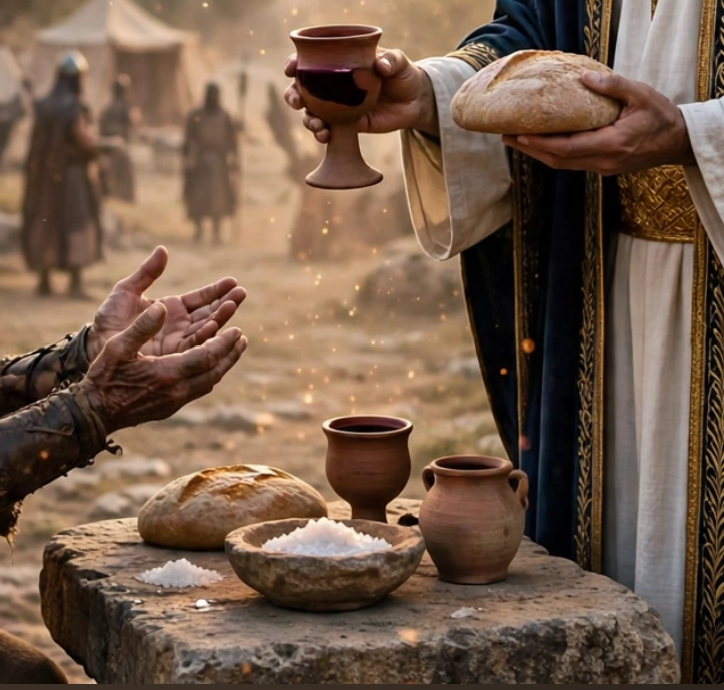
After rescuing Lot and defeating the coalition of kings, Abraham is met by a figure unlike any other in the biblical narrative:
“Then Melchizedek king of Salem brought out bread and wine. Now he was kohen of El Elyon.” (Genesis 14:18, TLV)
Melchizedek appears suddenly. No genealogy is given. No ancestry is provided. No explanation accompanies his arrival.
Later rabbinic tradition identified Melchizedek with Shem, the son of Noah. Yet Genesis itself never makes that claim. Instead, the text seems intentionally designed to draw attention away from genealogy and toward priesthood and authority.
The author of Hebrews later emphasizes this same mystery, describing a priesthood not rooted in ancestry but in divine appointment. The mystery is significant because covenant authority in Scripture flows from the Father through the Word. If Melchizedek is functioning within that covenant structure, then his role in Genesis 14 may be far greater than many readers realize.
The question is not merely:
Where did Melchizedek come from?
The larger question is:
Why did Abraham need to meet him before the royal grant, confirmed by a covenant of the pieces, in Genesis 15?
2. This Was Not Hospitality
Most modern readers assume Melchizedek brought bread and wine simply to refresh Abraham after battle. The ancient world would have understood something very different.
Much of the covenant background discussed in this article comes from the work of H. Clay Trumbull. His three major studies, The Blood Covenant (1885), The Threshold Covenant (1896), and The Salt Covenant(1899), are now in the public domain and freely available online. Together they document how blood, thresholds, covenant meals, and salt functioned as legal instruments throughout the ancient world.
Drawing heavily on evidence assembled in The Blood Covenant and The Salt Covenant, covenant meals were not merely social events. They established obligations, loyalty, representation, protection, and belonging.
Bread and wine were not refreshments. They were covenant tokens.
Melchizedek was not offering hospitality. He was offering covenant.
Genesis 14 is not describing a celebratory meal after military victory. It is recording a legal transaction.
3. What Did Melchizedek Offer Abraham?
Throughout Scripture, covenant relationships follow a consistent pattern.
The greater party offers:
- provision
- protection
- inheritance
- blessing
The lesser party responds with:
- loyalty
- fidelity
- obedience
- covenant participation
That pattern first appeared in Genesis 12.
The Father, through His Word, offered Abraham:
- land
- blessing
- descendants
- inheritance
Abraham responded by crossing the threshold and entering covenant. Now the covenant deepens.
Melchizedek blesses Abraham:
“Blessed be Abram by El Elyon, Creator of heaven and earth, and blessed be El Elyon, who gave over your enemies into your hand.” (Genesis 14:19-20, TLV)
This blessing is far more than encouragement. It is a legal affirmation that the covenant remains in force. The bread, wine, and salted covenant meal establish continuing relationship between the parties.
The threshold covenant granted access. Genesis 14 establishes covenant loyalty.
4. What Did Abraham Offer Melchizedek?
Abraham’s response is often treated as a lesson about tithing. Yet Genesis is doing something much larger.
Abraham gives Melchizedek a tenth of everything. This is not payment. It is acknowledgment. It is covenant reciprocity.
The greater party offers blessing. The lesser party offers loyalty. Abraham publicly acknowledges Melchizedek’s authority and priesthood. The covenant meal therefore creates obligations on both sides.
This is one of the most important principles of covenant. Provision requires fidelity. Protection requires loyalty. Inheritance requires covenant participation.
Genesis 14 records Abraham’s willing acceptance of those obligations.
5. Why Bread and Wine?
The elements themselves matter. Bread speaks of flesh. Wine speaks of blood. Salt speaks of permanence. Together they form a covenant package communicating life, loyalty, and enduring commitment.
According to Trumbull’s research, bread and salt shared between covenant partners frequently represented enduring loyalty, while blood and its symbolic substitutes represented pledged life and covenant obligation.
Yet the significance of Genesis 14 extends beyond symbolism. Within the covenant architecture established in Genesis 12-15, bread, wine, and salt accomplish something legally necessary.
The threshold covenant of Genesis 12 established access. The covenant meal of Genesis 14 established reciprocal covenant obligations. Through this meal Abraham and Melchizedek entered reciprocal obligations involving life, loyalty, representation, and covenant faithfulness.
This is why the identity of Melchizedek matters so much. If Melchizedek is merely another priest, Genesis 14 becomes an important covenant meal. If Melchizedek is the Word functioning as priest on behalf of the Father, Genesis 14 becomes indispensable.
6. The Legal Problem Approaching in Genesis 15
Most readers encounter Genesis 15 and focus on the dramatic image of the smoking oven and fiery torch passing between the pieces.
Yet a legal problem hides beneath the story. Genesis 15 requires a participant willing to accept a death-penalty covenant. The one who walks through the pieces assumes liability. The one who walks through the pieces must ultimately be capable of satisfying that liability.
Yet the Word, acting as the Father’s representative, is not mortal. How can the Word lawfully commit to a covenant obligation that culminates in death? Genesis 14 provides the answer.
The covenant meal establishes more than loyalty. It establishes legal reciprocity between Abraham and Melchizedek.
In the framework developed throughout Israel Divided: Why Jesus Came, this encounter becomes the moment the Word receives legal standing to participate in Abraham’s covenant line and ultimately assume covenant liability as Abraham’s promised Seed.
Without Genesis 14, Genesis 15 becomes difficult to explain. Without Genesis 14, the covenant of the pieces lacks a necessary legal foundation. Without Genesis 14, the later appearance of Messiah as both the Seed of Abraham and the bearer of covenant liability appears disconnected from the Abrahamic covenants.
Genesis 14 therefore is not an isolated story. It is preparation. It is the legal foundation upon which the covenant of the pieces will be built.
Closing Thought
The threshold covenant of Genesis 12 established covenant access.
The covenant meal of Genesis 14 established reciprocal covenant obligations.
The greater party offered blessing, provision, protection, and inheritance.
The lesser party responded with loyalty, fidelity, and acknowledgment.
Covenant reciprocity alone was not enough.
A royal grant also required responsibility for covenant failure.
If Melchizedek is merely a mysterious priest, Genesis 14 remains fascinating.
If Melchizedek is the Word acting in priestly function between the Father and Abraham, Genesis 14 becomes one of the most important covenant scenes in Scripture because it establishes the legal foundation for everything that follows.
In the next post, we will examine the covenant of the pieces in Genesis 15 and discover why the Word alone walked between the sacrifices, accepting a covenant obligation that would ultimately require His death.
Leave a Reply